Self-made DRL
The rules of the road require that in the daytime the car move with daytime running lights (DRL, DRL - Daytime running lights) on. Their function can be performed by:
- low beam headlights;
- fog lights;
- high-beam headlights, powered by low voltage on-board network of the car;
- separately installed lights.
The presence of DRL is required to improve the visibility of the car during the daytime and improve road safety. The main thing difference between DRL and parking lights in that they must ensure the visibility of the machine during the day, so their brightness must be high enough.
What should be the headlights
The following requirements are established for lighting devices operating as DRLs (GOST R 41.48-2004 and GOST R 41.87-99):
- they must be mounted on the front of the vehicle;
- DRLs must contain two light emitting elements installed at a height of not less than 250 mm, not more than 1500 mm and not closer than 600 mm from each other;
- from the edge of the car, the distance should not exceed 400 mm;
- glow color - only white;
- the luminous intensity must be at least 400 and not more than 800 candela;
- light emission area - not less than 40 sq.cm;
- the horizontal opening angle of the light launcher should be 20 degrees, the vertical - 10 degrees.
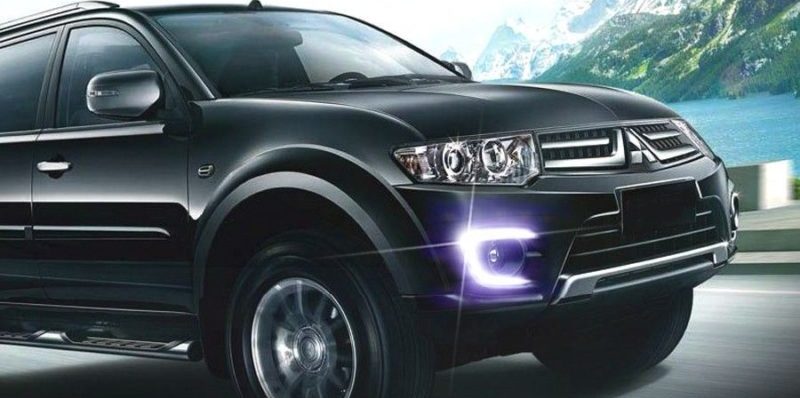
DRLs should turn on when the ignition is turned on. If the car is not equipped with DRL, you can make and install running lights yourself. Homemade lighting fixtures must meet all the specified requirements.
If light elements are installed on the car that are not provided for by the standard design of the car, the changes must be registered with the traffic police.
Read also: Description and interpretation of daytime running lights
What is needed to make
The best option is to make DRL on LEDs. This option will reduce the load on the car's on-board network, reduce the heating of the generator, and save battery power when starting the engine. Lights on LED strips look spectacular. But there are problems with the LED canvas:
- the length of the standard tape is a multiple of 1 meter, it is difficult to fit such a lamp in the dimensions of the front panel of the car in compliance with all the rules;
- the scattering angle of most LEDs is 120 degrees, which does not fit into the established standards, and it is problematic to make a focusing system for a long web.
Therefore, it is recommended to do DRL on separate LEDsinstalled in housings with reflectors that focus the luminous flux within the required limits.
Correct selection of components
The biggest problem is to provide a minimum level of light intensity of 400 cd. So, a common LED size 5730 has a half beam angle of 120 degrees. With a luminous flux of 50 lm, the luminous intensity will be only 16 cd.Calculations show that when installing a focusing system (lens and (or) reflector) concentrating the light flux within an angle of 20 degrees, the luminous intensity will increase by about 2 times (taking into account the use of the light flux and losses.), but in this case it is of decisive importance does not have.
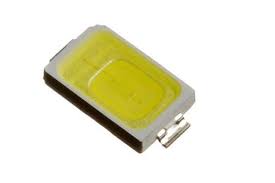
Necessary pay attention to LEDs with a power of 1W, and preferably 3W (taking into account the practice of overstating the declared characteristics by manufacturers). So, a three-watt white LED from Epistar gives a luminous flux of 300 lm and a luminous intensity of 95 candela. Taking into account the action of the focusing system, the minimum required 400 cd can be obtained from four such LEDs. Another condition is the radiation area of at least 40 sq.cm. With an LED lens diameter of 20 mm, its area will be about 3 sq. cm, and at least 10 such LEDs will be needed to obtain the required area. It is possible that the total light intensity will not exceed the established 800 cd, to obtain a real result, it is necessary to carry out laboratory measurements.
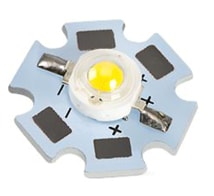
Such light-emitting elements cannot be installed without a heat-removing radiator - they are not designed for such a regime. The final list of materials will be as follows:
- the required number and type of LEDs (determined by calculation and selection);
- heat sink plate;
- focusing system;
- frame;
- connecting wires.
Next, you can start assembling the DRL.
| Light-emitting diode | Power, W | Angle, degrees | Color | Luminous flux, lm | Lens diameter, mm (radiating area, sq.cm) |
|---|---|---|---|---|---|
| ARPL-Star-1W-BCB | 1 | 120-140 | White | 120 | 20 (3) |
| Emitter 1W | 1 | 120 | 100 | 20 (3) | |
| Emitter LUX 1W | 1 | 120 | 130 | 20 (3) | |
| ARPL-Star-3W-BCB | 3 | 120-140 | 250 | 20 (3) | |
| STAR 3WR 3.6V | 3 | 150 | 20 (3) | ||
| High Power 3W | 3 | 120 | 200 | 20 (3) |
Assembly instructions
Before you start making DRLs with your own hands, you need to determine the installation location of home-made DRLs on the car. This sets the maximum possible dimensions of the housing of the lighting device. It is convenient to use fog lights as a housing, but this is not necessary.
Reflectors can be made independently from polished aluminum, but this is not for long. Such a surface will soon oxidize, the reflectivity will drop, the luminous intensity will decrease. It is necessary to use anodized aluminum, but it is not so easy to find it. It is better to use ready-made solutions. On many online trading platforms, there are ready-made focusing systems for standard LEDs for sale.
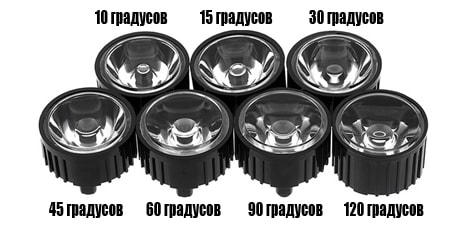
They can be used, but the problem is that each LED needs its own lens. If the increase in size does not scare, then this is the most convenient option.
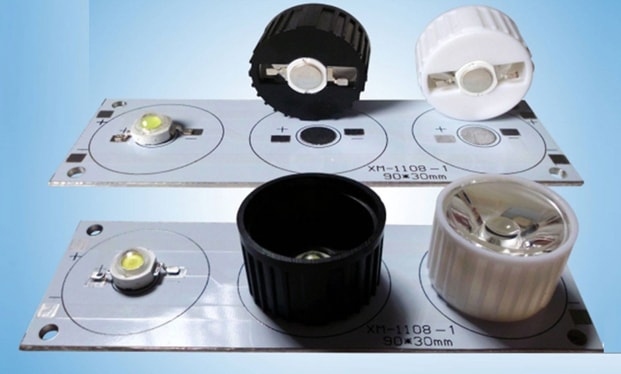
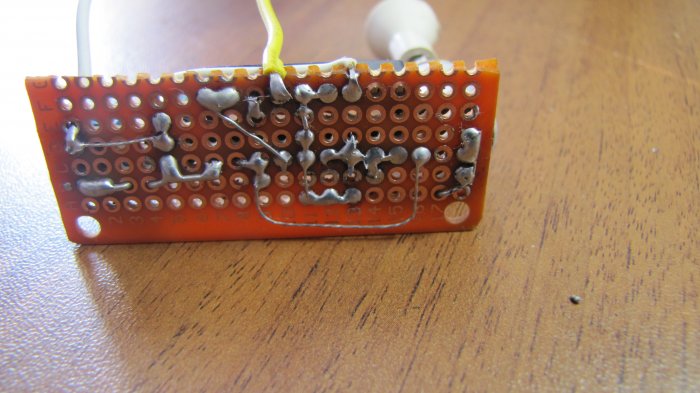
The required number of LEDs must be mounted on radiators. They can also be picked up ready-made. They serve as circuit boards and heatsinks, but their area is small for effective heat removal, so the plates must be reinforced with additional heatsinks. You can also make circuit boards yourself. Two conditions must be met:
- isolation of leads from the substrate;
- good heat transfer between the LED and the heatsink - you can use thermal paste for this.
Next, you need to connect the LEDs in consecutive chains, bring out the wires to connect to the car's on-board network and install the lights in the chosen place.
To power a group of LEDs from the car's on-board network, you need to install at least the simplest Voltage regulator. It can be done on the integral stabilizer LM7812. The problem is that for normal operation, such a stabilizer needs at least 13.5 volts at the input. If the voltage in the on-board network drops below (when powered by a battery), then the output will be less than 12 volts, which will lead to a drop in the luminous flux. If the stabilizer is not installed, then the LED will have an increased voltage, which will adversely affect the service life of the elements. You also need a ballast resistor. It's even better to use ready-made driver, designed for the corresponding input and output voltage and current, corresponding to the load power.
Important! More than three LEDs cannot be installed in a series chain - there is not enough voltage to open the LED transitions.
We recommend to read: How to choose running lights so as not to be fined, installation in accordance with GOST
Upon completion of the work, you can test the operation of the resulting system of running lights and go to the traffic police to legalize the lighting equipment. Without this, it is impossible to operate home-made lighting equipment..
3 more manufacturing methods are described in the video.