Marking and decoding headlights
Headlight markings are always on the back or side of the body. Having studied it, you can find out all the necessary information - from the date of production to the type of lamps installed. There is also data on the state that issued the permit for the production of headlights, the direction of movement and other characteristics related to the equipment.
Why do you need headlight markings
There are a number of international and domestic standards (for example, UNECE N99 and GOST R41.99-99), which oblige manufacturers of lighting equipment for transport to mark them according to a certain standard. Usually this is a code consisting of Latin letters and numbers, which contains the following data:
- Product model, version and modification, if several varieties are produced with certain differences.
- The type of light bulbs that can be used in a headlight.
- Key indicators of lighting.
- Product category.
- Orientation of the light flux (usually block headlights are made for right-hand or left-hand traffic and differ in the diffuser configuration).
- In which state was the certificate issued?
- Manufacturing date.
By the way! Individual brands (Koito, Hella) may provide additional information.
Usually the data is melted on the headlight housing. When installed at the factory, a label under the hood is also added, which duplicates the data so as not to remove the headlights when changing bulbs.
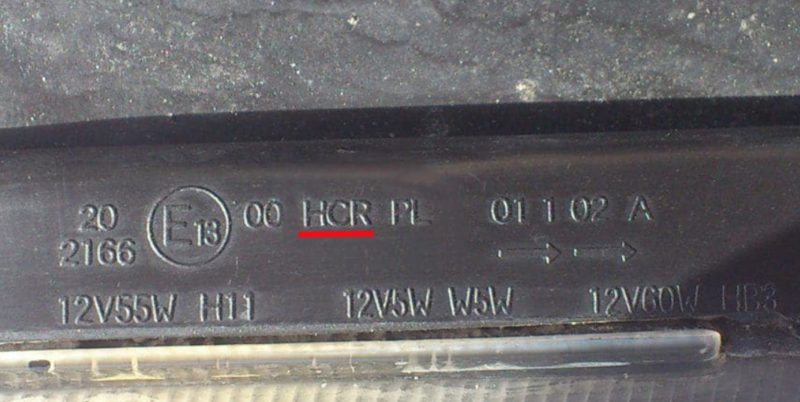
How to decipher the marking correctly
The easiest way to deal with the circuit, the layout is always the same. This applies to both the main headlights and fog lights, taillights, turn signals and other lighting equipment, if any.
What does the marking mean
For simplicity and clarity, a diagram is first given showing the location of different data groups. Below are explanations in order to quickly understand and find out all the necessary data about the equipment.
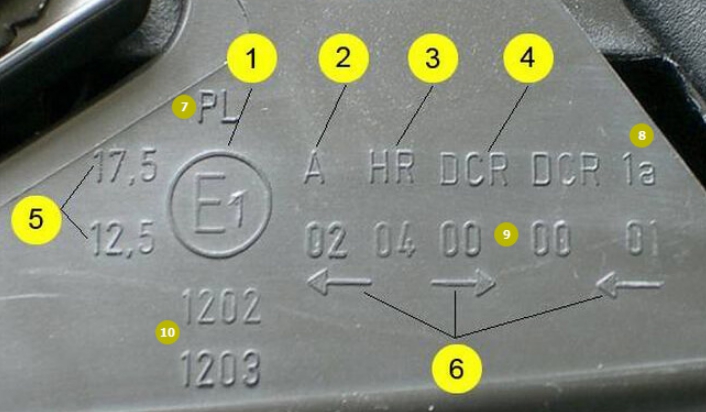
International approval mark, marked number "1" tells in which region the headlights or lanterns are certified. The most common options are:
- E - Europe.
- DOT USA.
- SAE is an association of automotive engineers.
Next to the letter code is a number that indicates the country that issued the certificate. Here are the main options:
- Germany.
- France.
- Italy.
- Netherlands.
- Sweden.
- Belgium.
- Hungary.
- Czech.
- Spain
- Yugoslavia (all former countries).
- Britannia
- Austria.
- Poland.
- Portugal.
- Russia
These are the main producing countries. Often there is a manufacturer's logo on the case, especially if the brand is well-known. Also, for simplicity, many mark the country of production so as not to deal with the codes.
Code under the number 2 shows the purpose of the headlight. There may be several options here:
- A - front position or side lights.
- L - rear license plate illumination element.
- R - rear dimensions.
- B - front foglights.
- F - rear fog lights.
These are the most common options used in labeling.
Number "3" indicates the type of lamp that is installed in the equipment. This aspect is discussed in detail in the next chapter.
Number "4" indicates which type of lamp to use. So, the DCR marking means that xenon bulbs can be installed for both high and low beams.
Under the number "5" in the diagram, the leading main number or VOC, which shows the intensity of the near and far illumination. It's simple - the higher the performance, the brighter the light equipment can give out. Such information is applied only to headlights in which there is a dipped and main beam.
Manufacturers are prohibited from making headlights with an RF frequency higher than 50 (150,000 candela), and the total value must not exceed 75.
The number "6" usually represents arrow arrows. They suggest what movement the light source is intended for. If the arrow points to the left - for the left-hand side, to the right - for the right-hand side. When there are both arrows, it is possible to use the headlights on roads with different directions of movement, but in this case it is necessary to adjust the equipment to adjust the luminous flux. If there are no markings, then the headlight (and this marking is only applicable to the head light) is intended for right-hand traffic, which is more common in the world.
If there is a marking on the case shown in the diagram number "7", this indicates that diffusers made of polymeric materials are used in the equipment.
The symbol under the number "8" if present, it indicates that a reflector is used in the design.
Number "9" It is intended for specialists in car services and shows the angles of inclination, which should be guided by when adjusting the light. They use data to simplify and speed up the process.
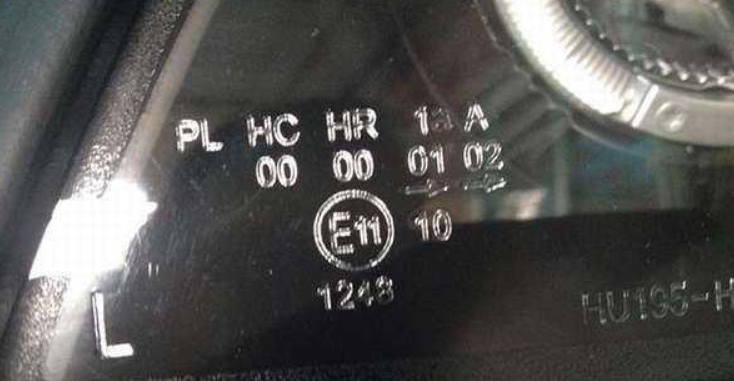
Number "10" informs about the standards that a particular product complies with. These can be both international norms and their own or regional options. The second line usually reflects the homologation number (improvement to improve performance).
Video: Where to watch the headlight number.
Varieties depending on the type of lamps
When deciphering the designations, the focus is usually on the type of light bulbs used and their features. Currently, there are three varieties that are installed on machines.
Halogen
The most common option, which has been the main one for several decades. Now less is used, but so far cars with halogen light are the most. As for the label, it's like this:
- HR - Bulb for high beam.
- HCR - a halogen lamp with two filaments, which provides low and high beams.
- HC/HR - in the block there are two separate modules for high and low beam sources.
By the way! If the HC/HR marking is on a headlight made in Japan, it can be converted to xenon.
Xenon
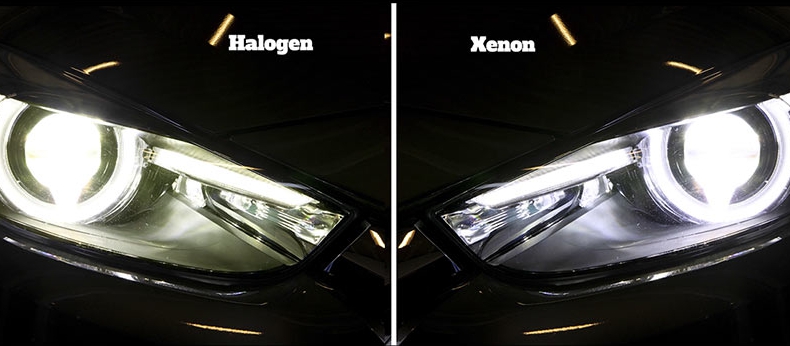
This option is increasingly being used in cars, as it provides powerful light with high brightness. On the headlights you can find the following designations:
- D2R. Reflector type, works like conventional lamps.
- D2S. Spotlights are inserted into the lenses and give a concentrated beam of light.
- DC. In such cases, xenon is placed in the dipped beam.
- DCR. Xenon headlight source.
- DC/DR. Two separate xenon modules for low beam and high beam.
From the video you will learn the principle of operation and the differences between halogen and xenon headlights.
LED
headlight markings led light bulbs has its own characteristics. This option can be designated by the standard HCR code used for halogen elements. But at the same time, ICE (LED) will always be embossed on the reflector and lens, so that it is clear that the elements are designed specifically for the LED light source.
If the equipment is designed for diodes, you can not put other light sources in itas they get much hotter and will damage the reflector or lens.
It is not difficult to understand the marking of headlights, it is always done according to a certain standard. This will help you quickly determine which bulbs the equipment is designed for and whether the light source is suitable for right-hand traffic.