Detailed description of the luminous flux of LED lamps
When designing lighting systems for premises, it is necessary to be guided by certain values in order to unify the calculation procedures. The same universal values are required for ordinary consumers in order to navigate in various types of light sources. For a long time, for incandescent lamps, this value was one watt of electrical power consumed. But these devices are going off the stage, so something else needs to be found.
What is luminous flux
In fact, to calculate the illumination, the designers previously used another value - the candela (candle), which also has a direct correspondence to the watts consumed by an incandescent lamp. In the technical literature of the beginning of the second half of the last century, one can find the expressions "a thousand-light lamp", etc. Luminance in candela refers to the power of light in watts emitted in a particular direction. As a visual association, such brightness is provided by an ordinary burning paraffin or stearin candle. Hence the name.This approach provides a visual representation of brightness as the number of candles burning.

Important! The watts used to calculate candela are not related to electrical power - the light source may not be electrical (same candle).
There is a definition for the concept of luminous flux - the power of radiation energy, which is estimated by light sensation. Or the number of photons emitted per unit of time. Mathematically, it looks like this: if a point source with a force of 1 candela radiates a flux into a solid angle equal to one steradian, then it creates a luminous flux of 1 lumen (lm).
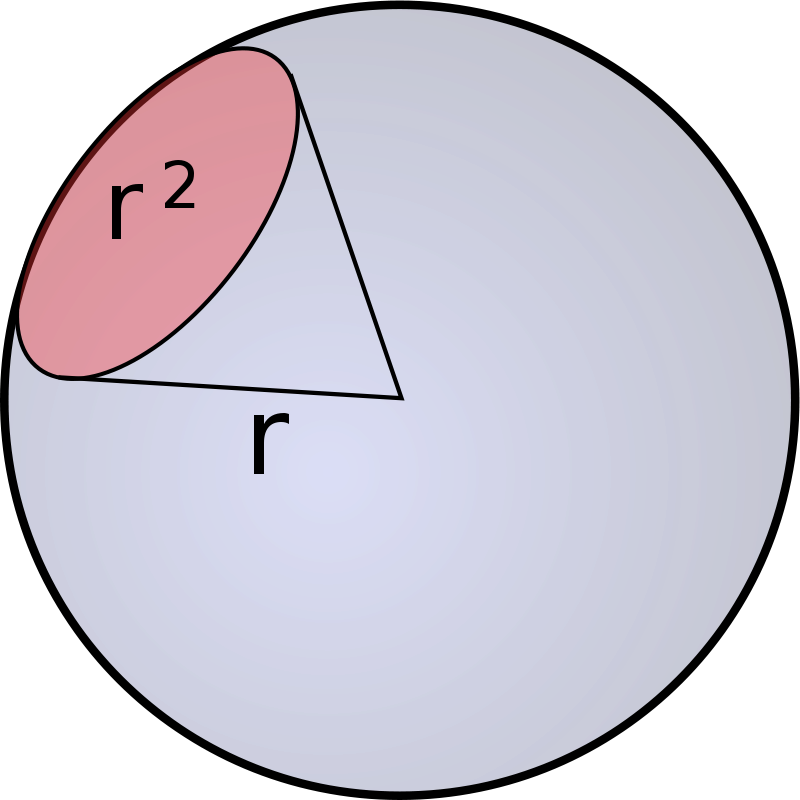
The concept of a steradian needs clarification. To represent a solid angle of 1 sr, you need to take a cone with a vertex at the center of a sphere of radius R, which cuts out an area on the surface of the sphere equal to R2 . The opening angle of such a cone is about 65 degrees.
If a point light source of 1 candela, radiating equally in all directions, is placed in a sphere with a radius of 1 m, then illumination equal to 1 lux (lx) will be created on its inner surface. This value is used to set the illumination norms. So, for various premises, according to SNiP, the following conditions must be met:
- classrooms of secondary schools - 500 lux;
- university audiences - 400 lux;
- gyms - 200 lx.
Lighting standards are also set for other rooms.
If a luminous flux of 1 lm falls on 1 sq.m. surface, it creates an illumination of 1 lux. Hence the relationship between lumen and lux: 1 lux = 1 lm/sq.m. For example, to provide sufficient illumination in an auditorium with an area of 100 square meters, a luminous flux of 40,000 lumens is needed.It should also be taken into account that the illumination decreases in proportion to the square of the distance from the light source, therefore The height of the lamp suspension is important.
Principle of operation
To understand the convenience of using all these quantities, it is necessary to consider the direction of emission of the LED, and related concepts.
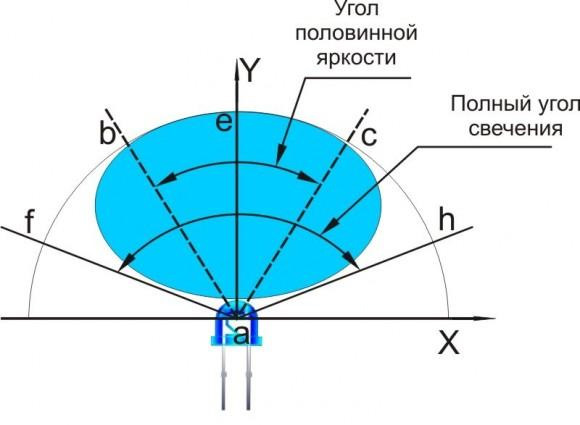
The design of the light emitting diode is such that it does not send light uniformly in all directions - the lower hemisphere is covered by the substrate, and the design of the lens is such that it does not provide uniform radiation in the upper hemisphere. As a result, the main light flux is concentrated in the upper direction and weakens towards the periphery of the light cone. At a certain angle of view, the intensity of the glow is reduced by half, and when an even larger angle is reached, the light becomes invisible. The first angle (bac) is called the half-brightness angle, and the second (fah) is called the full-brightness angle.
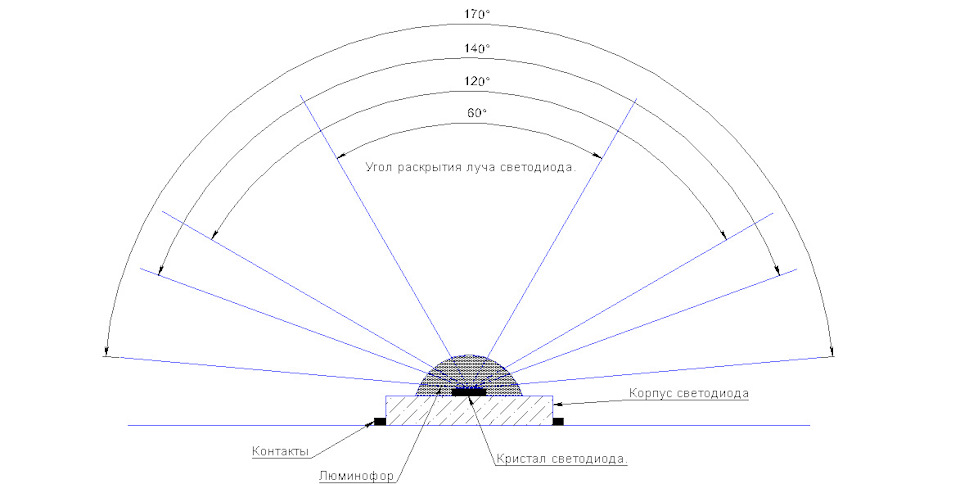
The same points apply to the LED with a phosphor. There, the radiation angle is limited by the substrate and the angle of the greatest activity of the initiating radiation of the p-n junction. It must be understood that it is impossible to accurately determine these angles by eye - special devices are needed. But you can visually compare two LEDs - which has a larger opening angle.
Light output of LED lamps
The light output of LED lamps does not depend on the degree of heating of the crystal. Almost all white illuminators are made on the basis of LED with a phosphor, so the light output depends on the quality of this phosphor, on the technology by which it is produced. Also important is the light emission of the initiating crystal and the ability of this radiation to cause the phosphor to glow in the visible region of the spectrum.
The strength of the luminous flux of outdoor lighting
To calculate outdoor lighting, one must proceed from the minimum illumination standards, which can also be found in the relevant SNiP (SP). So, for playgrounds, the minimum illumination should not be less than 10 lux.
The standards give the minimum values of illumination, in the calculations they can be increased.
To get the desired number of fixtures (N) to obtain the required illumination, you need to set the initial data:
- minimum illumination (E), lx;
- territory area (S), sq.m.;
- coefficient of illumination unevenness (z), for LED lamps it is equal to 1.2;
- a multiplier that takes into account the weakening of the luminous flux by the end of the service life of the lamp (k), for LED devices it is 1.2;
- luminous flux of one lamp (F), lm;
- coefficient of reflection of nearby objects (n), for asphalt it can be taken as 0.3.
These quantities are related by the formula N=E*S*z*k/(F*n).
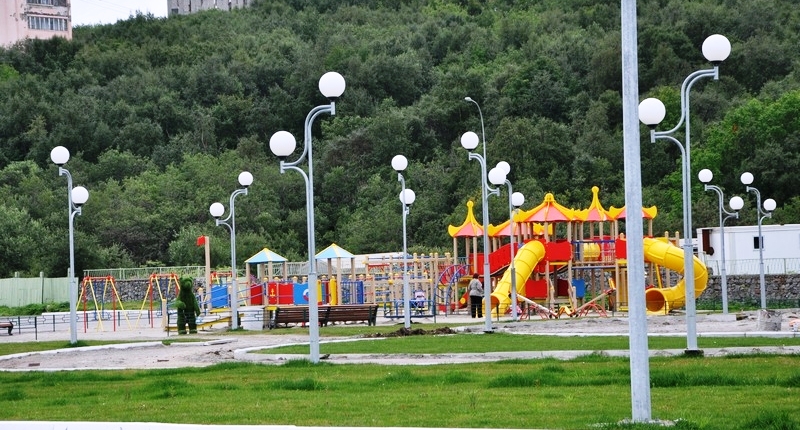
Let it be required to illuminate a playground with an area of 150 sq.m. In the presence of lamps emitting a luminous flux of 1500 lm each. Substituting the values into the formula, we get N=10*150*1.2*1.2/(1500*0.3). You get 4.8 or 5 lamps. This is the minimum amount, in fact you can install more.
You can set yourself not by the luminous flux of the available lamps, but by the number of lamps that can be installed on the territory. In this case, it is necessary to calculate the luminous flux of each lamp. The calculation formula will take the form F=E*S*k*z/(N*n). If the final result does not fall into the standard series lamp characteristics, it must be rounded up.
The relationship between lumens and watts
Consumers around the world have become accustomed to relating the brightness of lighting to the electrical power consumed during the decades of dominance of incandescent lamps. For these obsolete devices, this was reasonable - the development of technologies in this direction has long reached a dead end. The ratio of power and intensity of lighting has settled down and become a habit.
For LED lighting there is no direct relationship between the power consumption in watts and the generated luminous flux in lumens. More precisely, it is, but only at the moment. Technologies do not stand still, the production of crystals is being improved, new phosphors with increased light output are being developed. The ratios of the present time tomorrow will be hopelessly outdated.
Light brightness table
At the current moment, the correspondence between the luminous flux of modern LED lamps and the power they consume looks like this:
| Luminous flux, lm | 250 | 400 | 650 | 1300 | 2100 |
| Power consumption of the LED lamp, W | 2-3 | 5-7 | 8-9 | 14-15 | 22-27 |
| Equivalent power of an incandescent lamp, W | 25 | 40 | 60 | 100 | 150 |
The table shows approximate rounded values, as the lamps on the market have been produced for several years by different manufacturers with different technologies. For perception "by eye" this spread is practically not noticeable.
In conclusion, the video: The difference and relationship between watts, lumens and kelvins.
Having a clear understanding of the relationship between the characteristics of light radiation, you can independently calculate the lighting of a room or territory. To do this, you need to know the norms of illumination and the technical characteristics of LED lamps.