Features of lighting in kindergartens
Lighting in kindergarten must comply with a number of standards, since the health of children depends on this. If the conditions are violated, then over time it will affect the vision. Therefore, there are a number of regulations for preschool institutions, which clearly spell out the requirements for all premises in the kindergarten, as well as for playgrounds and surrounding areas.
Requirements and regulations
To properly organize lighting in kindergarten, you need to know the requirements and navigate them. Any impairment can harm children's vision. In addition, regulatory authorities, in case of non-compliance with lighting standards, can impose a penalty or even prohibit the operation of the institution until the violations are eliminated. When designing and planning lighting, you should be guided by two main regulations:
- SP 52.13330.2016 - there is a complete list of requirements for natural and artificial lighting in preschool institutions. You need to study the information in order to understand what indicators must be observed.
- SanPiN 2.2.1/2.1.1.1278-03 regulates the basic norms of illumination for public and residential premises. There are also separate requirements for kindergartens and similar institutions, so this document is also constantly used.
The first requirement is that the more natural light in the room, the better. Therefore, when planning buildings, designers usually try to make as many window openings as possible. This takes into account the following indicators for different rooms:
- Corridors and classrooms for educators - 200 lux with a pulsation rate of not more than 15%. The same standards apply to locker rooms, medical rooms and isolation wards where sick children are kept.
- Kindergarten groups, music and sports rooms, and playrooms should have a lighting level of 400 lux and a pulsation rate of no more than 10%.
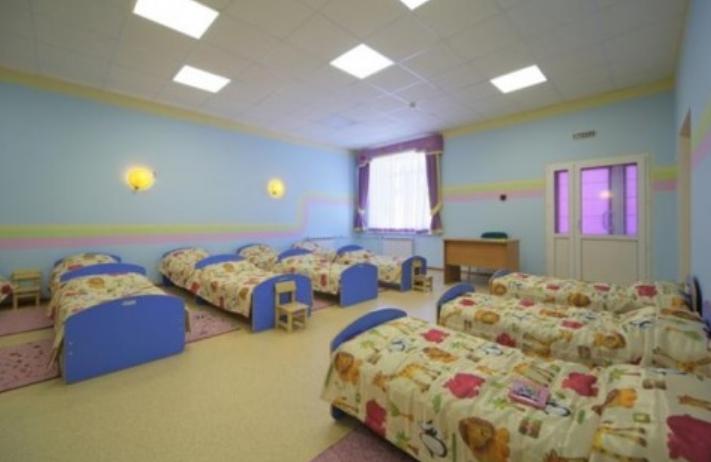
- For bedrooms, an illumination of 150 lux is sufficient, and the ripple can be up to 15%.
In addition to generally accepted acts in each region, there may be additional requirements. Therefore, it is necessary to clarify this point in organizations that control compliance with lighting conditions.
What should be natural / artificial lighting
In the regulatory framework, the requirements are clearly defined, so it is not difficult to understand all the nuances. In order not to study large documents with hundreds of points, you can make out the main points from them:
- If it is possible to provide an optimal level of illumination due to natural light, you need to bet on this option. The more light enters through the windows, the better, so the south-facing group windows are ideal, southeast or southwest is also suitable.
- It is often impossible to provide good daylight for various reasons: spreading trees with a dense crown growing near the windows, large buildings nearby blocking the sun. You also have to adapt if the room was not originally intended for a kindergarten and you need to adapt it to new conditions.
- The lack of natural light can also be due to natural causes: dense clouds, short daylight hours in winter, as well as in early spring and late autumn.
- Regardless of group lighting, playrooms and other areas where children spend a lot of time should have as much natural light as possible. And to comply with the norms indicated above, artificial light sources should be used.
- Some areas may not have natural light. This includes staff bathrooms, pantries, showers, as well as any other options necessary to ensure the operation of the institution.
- Natural light should fall on the children's tables from the left side. This should be taken into account when planning the arrangement of furniture in a group and others rooms. If the width is more than 6 meters, a two-sided option is used, in which the windows must be on both sides.
- When planning and determining the quality of natural lighting, it is necessary to take into account such an indicator as the coefficient of natural light (KEO).For kindergarten, it should be 1.5%.
- When installing luminaires in groups and other rooms of this type, you can use any equipment with suitable characteristics, designed for living rooms. And for corridors and landings, reinforced models designed for the street are chosen.
To ensure the best quality of lighting, both natural and artificial, you need to follow a few more recommendations:
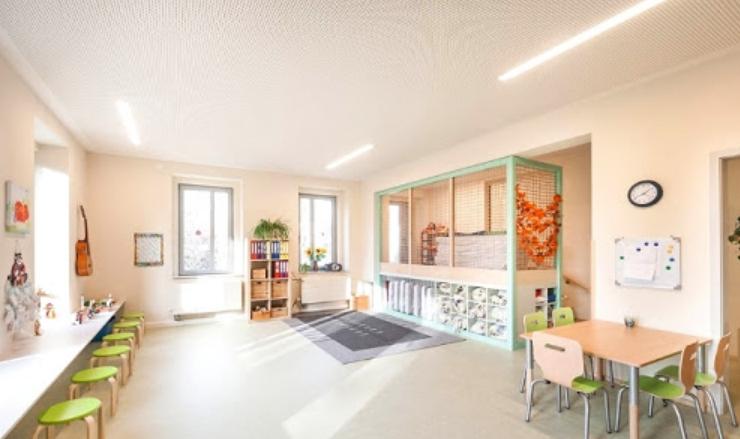
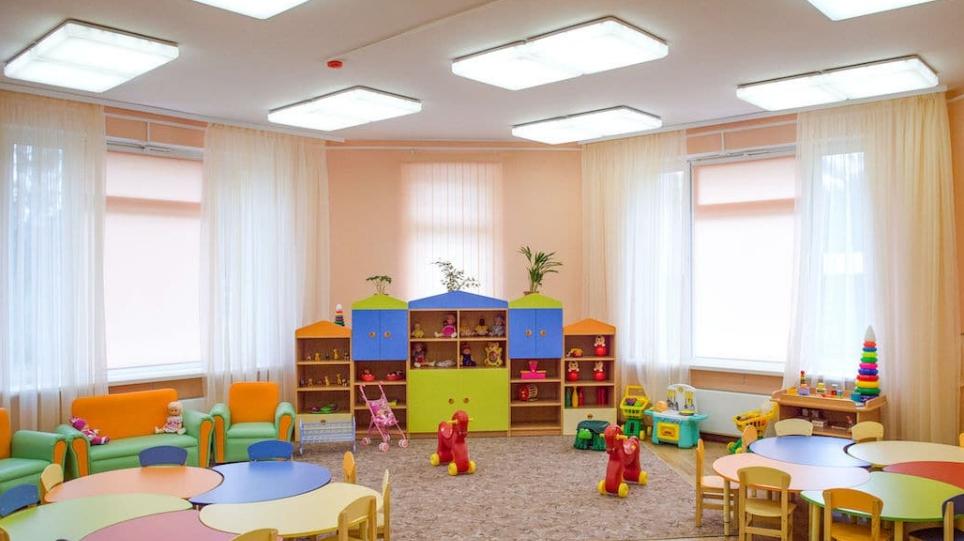
- Blinds are installed on all window openings to regulate the intensity of lighting. In addition, it will protect children from bright light that hits the eyes in the morning or evening hours.
- Use fabric curtains of light shades from natural materials.
- Choose light-colored floor, wall and ceiling materials to ensure high reflectivity and improve natural light.
- Furniture can be both light and with the texture of natural wood. In this case, the surface should be matte to exclude reflection of light and glare.
You need to measure the illuminance factor correctly. If the windows are located on one side, then choose a point on the floor a meter from the wall opposite the windows. If there are openings on both sides, then an arbitrary point is selected in the center of the room.
Organization of artificial lighting inside preschool institutions
If you look at the requirements in SP-251, then in paragraph 3.5.7 you can find clear instructions on which lamps can be used for children's institutions:
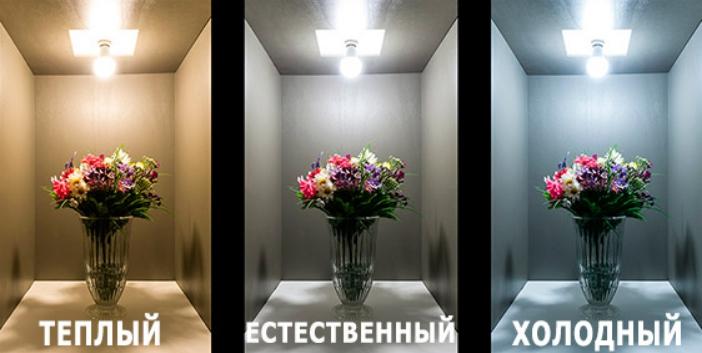
- There are three types of fluorescent lamps: LB - neutral white light, LHB - cool shade and LEC - natural tone with improved color rendering. It is also allowed to use compact light bulbs screwed into standard cartridges.
- Incandescent lamps. If this type is used, then the established illumination standards are reduced by two steps. In this case, the number of lamps is usually increased.
- Halogen lamps are essentially an improved version of standard products with a tungsten filament. The quality of light is excellent, so it can be used in kindergartens without restrictions.
The documentation was adopted in 2017, and the main norms were developed a year earlier. Therefore, some additions were later adopted, which will be described below. With regard to the features of the installation of artificial lighting elements, the following recommendations should be remembered:
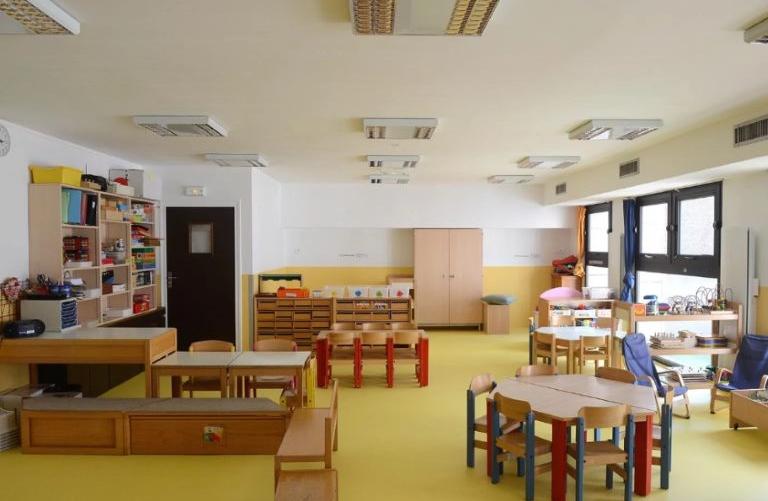
- If fluorescent lamps (fluorescent lamps) are used, then they must be placed in a line along the wall in which there are window openings. In this case, the distance to the outer wall must be at least 120 cm, from the inner wall - at least 150 cm.
- If other types of luminaires are used, they are selected according to characteristics similar to luminescent equipment. The location is also made the same as described above.
- If there is a board in the office, then it should be additionally highlighted. Lamps can be placed both on top and on the sides.
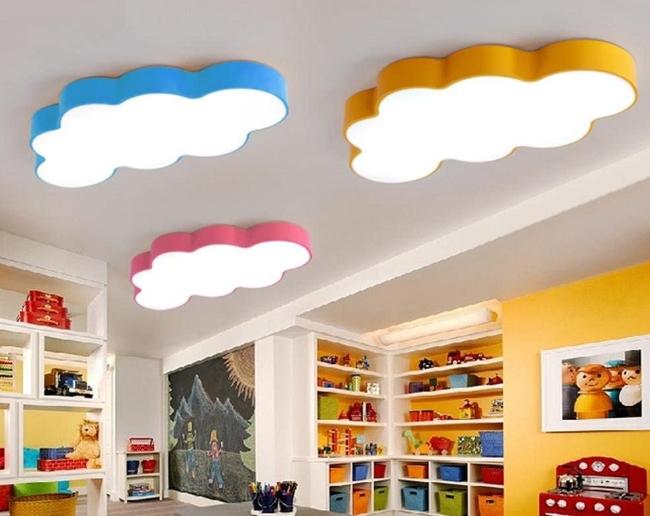
- The equipment used in the garden should be small and provide uniform lighting so that even the smallest elements can be seen.No dark areas in the corners or along the edges are allowed.
- Be sure to have diffusers, the light should not hit the eyes, even if the child looks at the lamp.
The level of electricity consumption should also be taken into account. If you choose modern energy-saving options, you can reduce energy costs significantly.
When choosing fixtures for corridors, landings and auxiliary rooms, external conditions and the required brightness are taken into account. It is better to give preference to lamps in a durable housing that is made without the use of glass to ensure safety.
Are LED lights allowed?
Many experts believe that ice lighting for kindergarten is prohibited for use, as there is a direct indication of this in building codes. But they were developed back in 2016, so some items are no longer valid.
On this issue, on January 19, 2019, the Ministry of Construction held a conference, at which they decided to consider the requirements in the joint venture not mandatory, but recommended. When choosing, first of all, it is necessary to be guided by the requirements SanPiN 2.2.1/2.1.1.1278-03, which does not prohibit the use of LED equipmentif it complies with the established standards.
But there is an important condition here - in order to ensure the optimal level of illumination in different rooms of the kindergarten, it is necessary to agree on the norms in the supervisory authority, which monitors compliance with optimal indicators. If earlier there were mandatory GOST standards, now they are not.New legislation is not even being developed yet, so it is better to coordinate decisions that differ from those prescribed in the regulations.
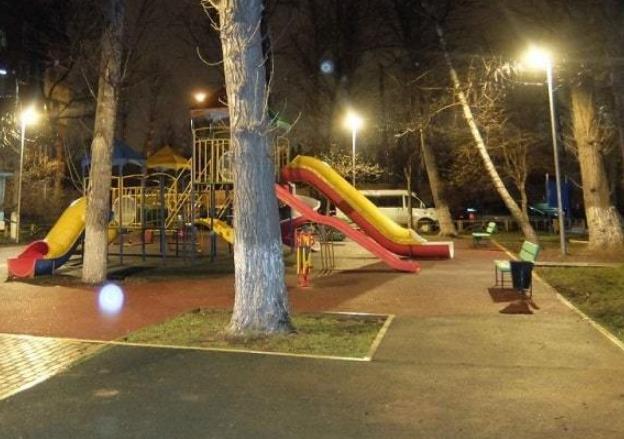
Illumination of playgrounds in gardens
Playgrounds in kindergartens also require attention, so it is worth considering a few important recommendations:
- In the daytime, there is usually enough natural light, since the sites are located in open space. There are no special requirements here, the only thing that can create problems is dense vegetation, trees should not be located close to the playing area.
- When using artificial lighting, it is necessary to be guided by the norm of horizontal average illumination of 10 lux. This is a minimum, in fact the light can be brighter, but at the same time it should not create discomfort for children.
- Shades should be used to diffuse the light. Use only luminaires designed for outdoor installation with high protection against moisture and dust. The location is planned in advance, it is important that the lighting is uniform over most of the site. Wiring must be carried out in accordance with safety regulations.
- It is best to choose LED lights with a shockproof housing that can withstand being hit by a ball or other object. They last about 50,000 hours and consume little electricity, so the higher cost is offset in a year of use.
Providing good lighting in a kindergarten or other preschool is very important, as the child's vision depends on it.To eliminate problems, one must be guided by established standards and obtain permits from authorized bodies, if necessary. If possible, provide as much natural light as possible, do not forget about the illumination of corridors, stairs and playgrounds on the street.
Territories of all kindergartens to be illuminated in Cherepovets within a year